|
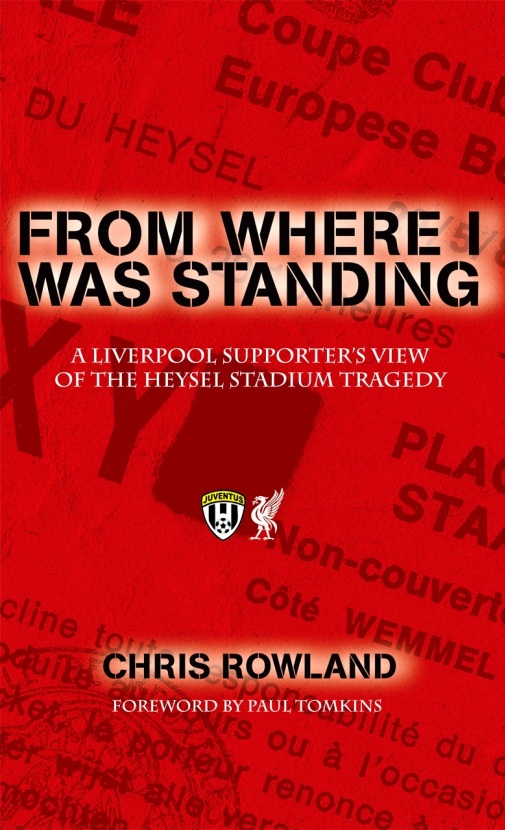
"From Where I Was
Standing: A Liverpool
Supporter's View of the Heysel Stadium Tragedy"
 Brussels,
Belgium, 1985. Liverpool are contesting their fifth
European Cup Final in just nine seasons. But what starts
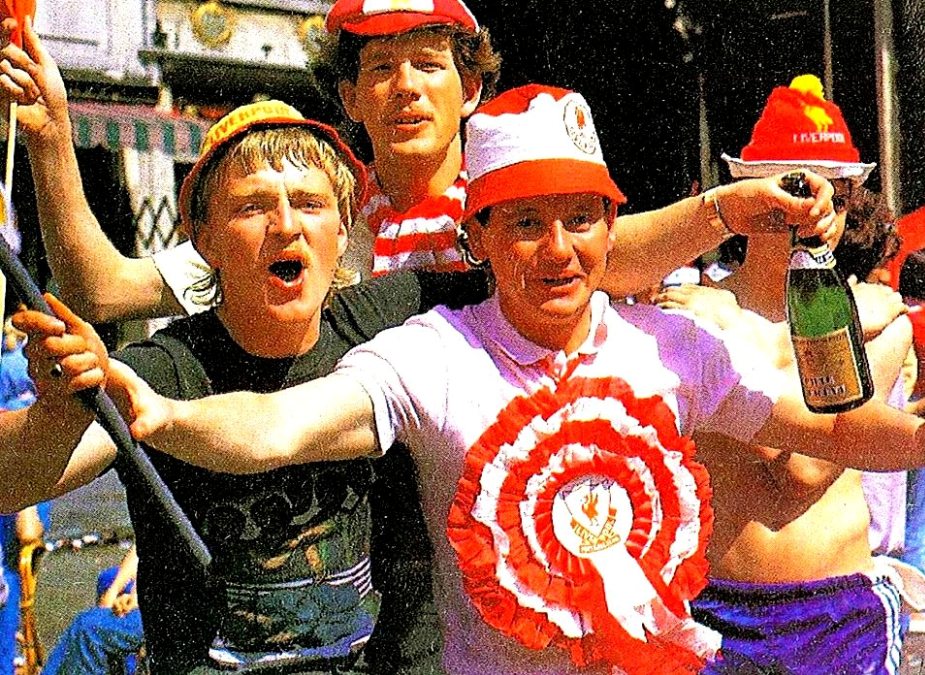
out as the usual care-free continental trip for Chris
Rowland and his friends ends up as the darkest night of
their lives. A wall in a decrepit stadium collapses, and
as a result 39 Juventus fans lay dying. From Where i Was
standing starts out as an amusing account of the build-up
to the final - an experienced group of eight travelling
Reds enjoying the delights of yet another big European
occasion – before the mood in Brussels turns
increasingly dark, and tragedy ensues. What follows is
an honest, personal account of what took place inside
the stadium that night; one which sets the record
straight about an event that tarred all Liverpool fans
with the same brush. It concludes with an examination of
the aftermath: the world’s reaction (including shocking
hostility aimed towards those simply there to watch a
match), the official inquests (which apportioned blame
far beyond those culpable Liverpool fans), and the
punishment meted out to those held responsible. Brussels,
Belgium, 1985. Liverpool are contesting their fifth
European Cup Final in just nine seasons. But what starts
out as the usual care-free continental trip for Chris
Rowland and his friends ends up as the darkest night of
their lives. A wall in a decrepit stadium collapses, and
as a result 39 Juventus fans lay dying. From Where i Was
standing starts out as an amusing account of the build-up
to the final - an experienced group of eight travelling
Reds enjoying the delights of yet another big European
occasion – before the mood in Brussels turns
increasingly dark, and tragedy ensues. What follows is
an honest, personal account of what took place inside
the stadium that night; one which sets the record
straight about an event that tarred all Liverpool fans
with the same brush. It concludes with an examination of
the aftermath: the world’s reaction (including shocking
hostility aimed towards those simply there to watch a
match), the official inquests (which apportioned blame
far beyond those culpable Liverpool fans), and the
punishment meted out to those held responsible.
 Fonte: GPRF
Publishing
© 20 ottobre 2009
Fotografie: GPRF
Publishing
© Chris Rowland
©
Paris Match ©
Fonte: GPRF
Publishing
© 20 ottobre 2009
Fotografie: GPRF
Publishing
© Chris Rowland
©
Paris Match ©
|
|
Heysel, 30 anni dopo:
intervista a Chris Rowland
"Volevamo essere orgogliosi dei reds, non vergognarci"
di Paolo Avanti
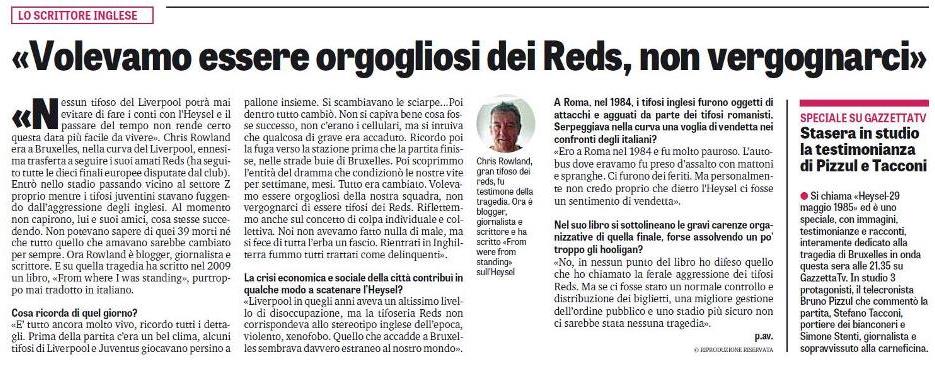
"Nessun
tifoso del Liverpool potrà mai evitare di fare i conti
con l’Heysel e il passare del tempo non rende certo
questa data più facile da vivere". Chris Rowland era a
Bruxelles, nella curva del Liverpool, ennesima trasferta
a seguire i suoi amati Reds (ha seguito tutte le dieci
finali europee disputate dal club). Entrò nello stadio
passando vicino al settore Z proprio mentre i tifosi
juventini stavano fuggendo dall’aggressione degli
inglesi. Al momento non capirono, lui e suoi amici, cosa
stesse succedendo. Non potevano sapere di quei 39 morti
né che tutto quello che amavano sarebbe cambiato per
sempre. Ora Rowland è blogger, giornalista e scrittore.
E su quella tragedia ha scritto nel 2009 un libro, "From
where I was standing", purtroppo mai tradotto in
italiano.
Cosa ricorda di quel giorno ?
"E’ tutto ancora molto vivo, ricordo tutti i dettagli.
Prima della partita c’era un bel clima, alcuni tifosi di
Liverpool e Juventus giocavano persino a pallone
insieme. Si scambiavano le sciarpe… Poi dentro tutto
cambiò. Non si capiva bene cosa fosse successo, non
c’erano i cellulari, ma si intuiva che qualcosa di grave
era accaduto. Ricordo poi la fuga verso la stazione
prima che la partita finisse, nelle strade buie di
Bruxelles. Poi scoprimmo l’entità del dramma che
condizionò le nostre vite per settimane, mesi. Tutto era
cambiato. Volevamo essere orgogliosi della nostra
squadra, non vergognarci di essere tifosi dei Reds.
Riflettemmo anche sul concetto di colpa individuale e
collettiva. Noi non avevamo fatto nulla di male, ma si
fece di tutta l’erba un fascio. Rientrati in Inghilterra
fummo tutti trattati come delinquenti".
La crisi economica e sociale della città contribuì in
qualche modo a scatenare l’Heysel ?
"Liverpool in quegli anni aveva un altissimo livello di
disoccupazione, ma la tifoseria Reds non corrispondeva
allo stereotipo inglese dell’epoca, violento, xenofobo.
Quello che accadde a Bruxelles sembrava davvero estraneo
al nostro mondo".
A Roma, nel 1984, i tifosi inglesi furono oggetti di
attacchi e agguati da parte dei tifosi romanisti.
Serpeggiava nella curva una voglia di vendetta nei
confronti degli italiani ?
"Ero a Roma nel 1984 e fu molto pauroso. L’autobus dove
eravamo fu preso d’assalto con mattoni e spranghe. Ci
furono dei feriti. Ma personalmente non credo proprio
che dietro l’Heysel ci fosse un sentimento di vendetta".
Nel suo libro si sottolineano le gravi carenze
organizzative di quella finale, forse assolvendo un po’
troppo gli hooligan ?
"No, in nessun punto del libro ho difeso quello che ho
chiamato la ferale aggressione dei tifosi Reds. Ma se ci
fosse stato un normale controllo e distribuzione dei
biglietti, una migliore gestione dell’ordine pubblico e
uno stadio più sicuro non ci sarebbe stata nessuna
tragedia".
Fonte: La Gazzetta dello Sport ©
29 maggio 2015 (Testo
©
Fotografia)
|
|
THE TOMKINS TIMES
LIBRO HEYSEL DI CHRIS
ROWLAND: INTERVISTA
di Paul Tomkins
Alla fine dello scorso
anno, Chris Rowland ha pubblicato "From Where I Was
Standing", il suo resoconto del disastro dell'Heysel,
per il quale ho scritto la prefazione. Essendo un membro
di questo sito, gli ho recentemente posto alcune domande
sulle esperienze di 25 anni fa.
Cosa ti ha spinto a
scrivere From Where I Was Standing ?
Ciò che mi ha spinto a
scrivere il libro è stata la convinzione che la storia
non fosse stata raccontata in modo adeguato. C'era, e
rimane tuttora, la forte sensazione che la vicenda
dell’Heysel sia ancora irrisolta. Spero che questo libro
induca i lettori a interrogarsi o a riconsiderare ciò
che sanno dell’Heysel. Fu la valanga di semplificazioni
eccessive, ipocrisia e falsità che ne seguì, ovviamente
dai media, ma anche dal governo Thatcher con la sua
agenda anti-Liverpool e anti-calcio. Oh, e da
praticamente chiunque incontrassi, al pub, al lavoro e,
naturalmente, dai tifosi delle squadre rivali. Provavo
un bruciante senso di ingiustizia per come la situazione
veniva presentata - lo stesso istinto che ancora oggi
prevale regolarmente su questo sito - e volevo sfogarmi
scrivendone. C'era un elemento catartico, suppongo. Non
mi piaceva vedere il nostro glorioso club trascinato nel
fango. E non mi piace tuttora. La strage dell’Heysel è
stata la prima volta in oltre 20 anni consecutivi di
competizioni europee che i tifosi del Liverpool sono
stati coinvolti in gravi episodi di violenza. Heysel
era, ed è tuttora, totalmente estranea alla cultura
calcistica del Liverpool. Se prima dell’Heysel il
Liverpool veniva etichettato come il tipico gruppo di
hooligan del calcio inglese, non lo meritava. Non
corrispondeva allo stereotipo di tifosi violenti,
ubriachi, pieni d'odio, razzisti e xenofobi, non
aspirava a essere un esercito di occupazione
inarrestabile. Ecco perché l’Heysel è stato
particolarmente difficile da comprendere e da accettare.
È stato facile
scrivere questo libro ? Quanto tempo ci è voluto ?
 La parte del diario è stata
abbastanza facile, dato che la scaletta è stata scritta
nei mesi successivi, quindi avevo tutto ben chiaro
finché era ancora fresco. L'analisi è stata più
difficile e ho trovato molto complicato cercare di
catturare le complesse emozioni che mi turbinavano
dentro. Non hai una bussola in una situazione del
genere, niente a cui attingere dall'esperienza, devi
inventarti tutto da solo, strada facendo. Ci sono voluti
anni prima che venissero redatti i rapporti, che si
portassero avanti i processi e le richieste di
estradizione, che emergessero altre testimonianze -
ricordate che all'epoca non c'era internet, non era
affatto facile raccogliere informazioni come lo è ora,
bisognava andare in biblioteca e sfogliare i giornali.
Man mano che emergeva ogni nuovo frammento, cercavo di
integrarlo in quello che era iniziato come un semplice
diario. Ho pensato di provare a pubblicarlo a puntate
sul Liverpool Echo e ho inviato alcuni estratti. A loro
è piaciuto e mi hanno chiesto di inviare il manoscritto
completo. È arrivato puntualmente sulla scrivania del
responsabile della sezione sportiva il 15 aprile 1989,
mentre ero in viaggio per Hillsborough. Ho ricevuto una
lettera di risposta in cui mi comunicavano che, date le
circostanze, non avrebbero dato ulteriore seguito al mio
libro. Ancora oggi ne sono stupito. Il libro che è
uscito ora è una versione molto diversa e ampliata di
quello che è stato inviato all'Echo quel giorno. Ho
continuato ad aggiungere, riscrivere, rifinire,
snellire, aggiungere e togliere parti per esprimere al
meglio ciò che volevo dire. Ho anche dovuto trascriverlo
di nuovo al computer, dato che in origine era
dattiloscritto, il che lo rende un po' datato ! Poi l'ho
lasciato lì, prima di rendermi conto che non serviva a
niente tenerlo sul mio computer, avrei dovuto cercare di
renderlo disponibile al pubblico. Solo che ora c'era un
nuovo canale: i siti web dei fan. Conoscevo i tuoi
scritti e i tuoi libri, quindi ti ho contattato per
chiederti aiuto. La versione definitiva è stata
finalmente approvata e firmata alla fine dell'estate del
2008, quindi immagino che il suo periodo di gestazione
sia stato di soli 23 anni ! Non puoi certo accusarmi di
averlo fatto di fretta. La parte del diario è stata
abbastanza facile, dato che la scaletta è stata scritta
nei mesi successivi, quindi avevo tutto ben chiaro
finché era ancora fresco. L'analisi è stata più
difficile e ho trovato molto complicato cercare di
catturare le complesse emozioni che mi turbinavano
dentro. Non hai una bussola in una situazione del
genere, niente a cui attingere dall'esperienza, devi
inventarti tutto da solo, strada facendo. Ci sono voluti
anni prima che venissero redatti i rapporti, che si
portassero avanti i processi e le richieste di
estradizione, che emergessero altre testimonianze -
ricordate che all'epoca non c'era internet, non era
affatto facile raccogliere informazioni come lo è ora,
bisognava andare in biblioteca e sfogliare i giornali.
Man mano che emergeva ogni nuovo frammento, cercavo di
integrarlo in quello che era iniziato come un semplice
diario. Ho pensato di provare a pubblicarlo a puntate
sul Liverpool Echo e ho inviato alcuni estratti. A loro
è piaciuto e mi hanno chiesto di inviare il manoscritto
completo. È arrivato puntualmente sulla scrivania del
responsabile della sezione sportiva il 15 aprile 1989,
mentre ero in viaggio per Hillsborough. Ho ricevuto una
lettera di risposta in cui mi comunicavano che, date le
circostanze, non avrebbero dato ulteriore seguito al mio
libro. Ancora oggi ne sono stupito. Il libro che è
uscito ora è una versione molto diversa e ampliata di
quello che è stato inviato all'Echo quel giorno. Ho
continuato ad aggiungere, riscrivere, rifinire,
snellire, aggiungere e togliere parti per esprimere al
meglio ciò che volevo dire. Ho anche dovuto trascriverlo
di nuovo al computer, dato che in origine era
dattiloscritto, il che lo rende un po' datato ! Poi l'ho
lasciato lì, prima di rendermi conto che non serviva a
niente tenerlo sul mio computer, avrei dovuto cercare di
renderlo disponibile al pubblico. Solo che ora c'era un
nuovo canale: i siti web dei fan. Conoscevo i tuoi
scritti e i tuoi libri, quindi ti ho contattato per
chiederti aiuto. La versione definitiva è stata
finalmente approvata e firmata alla fine dell'estate del
2008, quindi immagino che il suo periodo di gestazione
sia stato di soli 23 anni ! Non puoi certo accusarmi di
averlo fatto di fretta.
Qualcuno sul Tomkins
Times ha descritto il libro in questo modo: "All'inizio
mi è sembrato quasi di leggere una commedia d'azione,
poi lentamente ho sentito il mio cuore sciogliersi". A
che punto ti sei reso conto che c'era qualcosa di
diverso in questo viaggio in particolare ?
Beh, la parte del racconto era
proprio così, era un riflesso di ciò che è successo come
lo abbiamo visto noi, quindi sì, è iniziato come
qualsiasi altro concerto europeo, solo tanto
divertimento, risate e bevute, cose divertenti che
succedevano ecc. Ma sai com'è finita, è un po' come
guardare Titanic, tutte le cene eleganti e gli abiti
formali accompagnati da un quartetto che suona Mozart e
Bach assumono una sfumatura completamente diversa quando
sai cosa succederà, come finirà questa storia. Certo,
non avevamo idea di cosa sarebbe successo. Ho solo
cercato di catturare accuratamente l'atmosfera
prevalente in ogni fase del viaggio, quindi sì, è
cambiata drasticamente. L'atmosfera nel libro, e anche
nella nostra esperienza, iniziò a cambiare nel tardo
pomeriggio, quando si verificarono alcuni disordini
nella Grand Place, quella fantastica piazza nel cuore di
Bruxelles. Non tra tifosi, dato che in città non c'erano
quasi tifosi della Juve, ma ci furono degli scontri tra
tifosi del Liverpool e la polizia dentro e intorno alla
piazza. Non ne fummo testimoni diretti, ma ne vedemmo le
conseguenze: l'atmosfera era cambiata. Ma non
dimentichiamo che a quel tempo l'atmosfera che
circondava la maggior parte delle partite era piuttosto
tesa, quindi non era peggio di quello a cui eravamo
abituati, certamente non sufficiente a prevedere l'esito
catastrofico. D'altra parte, all'epoca non eravamo a
conoscenza delle circostanze che si verificarono
all'Heysel, delle modalità di vendita dei biglietti per
il Blocco Z, dell'inadeguata separazione dei settori e
della presenza della polizia, e delle condizioni dello
stadio: non solo fatiscente, ma addirittura pericoloso.
|
|
Secondo
te, in che modo si sarebbe potuto evitare e con quanta
facilità ?
Le morti all'Heysel erano del
tutto e facilmente evitabili. Se solo fossero state
adottate le normali precauzioni previste per le partite
- niente di speciale, semplicemente quelle che si
adottavano in Inghilterra per ogni singola partita a
metà degli anni '70 - allora le morti non solo sarebbero
state evitabili, ma impossibili. Sarebbe stato fin
troppo facile negare a quella brutale e primitiva
aggressione tribale il suo palcoscenico. Il primo e più
ovvio fattore fu la vendita dei biglietti per il Settore
Z, dove crollò il muro e si verificarono le morti. 5000
biglietti, presumibilmente neutrali, per quel settore
che faceva parte della stessa curva del gruppo
principale di tifosi del Liverpool, erano stati messi in
vendita a Bruxelles, città con una numerosa comunità di
espatriati italiani. Quindi il Settore Z era pieno di
tifosi della Juve. A differenza di qualsiasi altra
partita giocata in Inghilterra fino ad allora, non c'era
separazione, nessuna zona cuscinetto tra le due
tifoserie e nessun cordone di polizia. Solo un fragile
tratto di rete metallica e pochi poliziotti nelle
retrovie, che non fecero nulla quando scoppiarono i
disordini. Il capitano di polizia responsabile della
sicurezza allo stadio Heysel fu in seguito accusato di
omicidio colposo. Poi c'è stata l'insistenza della UEFA
nell'utilizzare quel cantiere come sede, nonostante il
Liverpool avesse sollevato preoccupazioni sia in merito
che sulla vendita dei biglietti. Ci sarebbero stati
oltre 50.000 tifosi, la maggior parte dei quali sulle
gradinate, dove inevitabilmente si sarebbero verificati
picchi e oscillazioni che sono stati la causa principale
delle morti. Non si può utilizzare uno stadio che non
regge un picco di folla per una finale di Coppa dei
Campioni. Qualsiasi muro di quello stadio avrebbe potuto
crollare in qualsiasi momento sotto la pressione della
folla, non solo sotto quella provocata dagli hooligan.
Non intendo in alcun modo scagionare i tifosi del
Liverpool per il loro ruolo in quanto accaduto.
Semplicemente, se si creano le circostanze che si sono
verificate all'Heysel, gli scontri tra tifosi non erano
una possibilità, ma una certezza, data la cultura delle
tribune all'epoca. Ma ciò che distingueva gli scontri e
le cariche all'Heysel dal comportamento a cui eravamo
abituati ogni settimana senza conseguenze era lo stato
dello stadio. In parole povere, quello scontro in
tribuna non avrebbe portato a nulla di più di un livido
e un naso sanguinante in qualsiasi stadio in buone
condizioni. Quella partita doveva essere l'ultima mai
giocata in quello stadio, poiché era stato dichiarato
inagibile molti anni prima per non aver soddisfatto i
moderni standard di sicurezza e progettazione. Di
conseguenza, erano stati investiti pochi soldi nella sua
manutenzione e ampie parti dello stadio erano in rovina.
La reazione che hai
ricevuto dal pubblico alla stazione ferroviaria di
Londra al tuo ritorno in Inghilterra mi ha scioccato. Te
l'aspettavi ?
No, per niente, non ci avevo
nemmeno pensato, anche se era un'anticipazione di ciò
che ci aspettava. Gente che ci urlava "assassini" sulle
scale mobili della metropolitana, cose del genere, le
telecamere della TV britannica che aspettavano il nostro
treno alla stazione di Ostenda nelle prime ore del
giovedì mattina, i giornali locali che assillavano le
nostre famiglie a casa, era un'ulteriore difficoltà da
affrontare, come se non avessimo già abbastanza problemi
da gestire.
Ovviamente la morte di
39 tifosi della Juventus è stata una cosa terribile,
come tu giustamente riconosci nel libro, e qualcosa che
sono sicuro ogni tifoso del Liverpool avrebbe preferito
non accadesse. C'è stato qualcosa di buono in questa
tragedia ? Dopotutto, è dopo eventi del genere che le
persone tendono a rinsavire.
A dire il vero, faccio fatica
a vedere qualcosa di buono in tutto questo, solo
un'infinita serie di aspetti negativi, dal divieto di
partecipare alle competizioni europee alle continue e
insensate accuse e agli insulti che riceviamo ancora
oggi (a proposito, visto che i tifosi dell’Everton sono
così sicuri che sarebbero stati campioni d'Europa la
stagione successiva, dovrebbero ricordare che non lo
sono stati nemmeno i campioni d'Inghilterra, i Reds
hanno fatto il double, quindi non erano poi così
invincibili). Non sono sicuro che qualcuno abbia
imparato qualcosa da Heysel. Tendo a credere che la
storia sia destinata a ripetersi. Le guerre si sono
forse fermate dopo le due guerre mondiali ? La UEFA ha
imparato la lezione e dovrebbe essere più attenta nella
scelta delle sedi per questi eventi ad alta tensione ?
Istanbul, con lo stadio a 40 chilometri dalla città, in
un luogo che sembra la luna e senza collegamenti di
trasporto ? Il caos di Atene ? Mosca ? L'assegnazione
dei biglietti, con così tanti biglietti condivisi tra la
"famiglia calcistica UEFA" che i club non ne hanno mai
abbastanza, quindi c'è sempre pressione da quella parte.
Ho cercato solo di presentare Heysel in un contesto più
ampio; non c'è stato nessun omicidio, niente di
eccezionale, finché un muro non è crollato e ha cambiato
tutto.
Fonte:
Tomkinstimes.com © 2 febbraio 2010
Fotografie:
GETTY IMAGES © (Not for Commercial Use) © Paul
Tomkins ©
|
|
THE TOMKINS TIMES
From
where I was standing by
Chris
Rowland
by Paul Tomkins
This is an article
written for the Reuters newsletter. (Chris works as a
writer for one of the branches of Reuters.) The book is
officially released this week.
From
Where I Was Standing’ is an eyewitness account and
analysis of the Heysel Stadium disaster in Brussels in
May 1985. What started out as the usual care-free
continental trip ended up in tragedy. A wall in the
decrepit stadium collapsed following fighting on the
terraces between fans of Liverpool and their opponents
Juventus of Turin, and 39 fans lost their lives, most of
them Juventus fans. I wrote these recollections because
I wanted to write it out of my system, but mostly
because I didn’t think the story had been properly told.
There was and remains a strong sense that what happened
at Heysel is unfinished business. Then I left it, only
adding bits as various items of relevant news followed.
Finally, I decided that it might be more use being
published than sitting on my computer. In fact it began
its life on a typewriter, which sort of dates it. The
book is initially an amusing (hopefully) account of the
build-up to the final, and an honest account of what
took place thereafter; one which I wrote to set the
record straight about an event that tarred all Liverpool
fans with the same brush. I do not seek to downplay the
role of hooliganism in the tragedy, merely that it could
so easily have been denied its stage. The spur for
writing an account of it, apart from the obvious fact
that it was a football match where 39 people died, is
the sense of injustice I felt at the simplistic,
monotone way it was reported, with all the blame laid at
the door of Liverpool’s fans, and of football fans
generally. But what I witnessed didn’t tally with what I
read and heard over the subsequent days and weeks.
In
1989 I tried to get the book serialised in the Liverpool
Echo. I sent samples, they asked me to send the rest. It
duly arrived at the newspaper on Saturday April 15th
1989 – the very day that the Hillsborough disaster
happened in Sheffield (I was there too, in the Leppings
Lane stand where the deaths occurred). Of course in the
circumstances the newspaper was no longer interested in
Heysel. I had provisionally called the book ‘Football’s
Blackest Day’, an echo of a newspaper headline at the
time of Heysel. After Hillsborough I had to revise it.
Heysel has remained unfinished business – although to
this day rival fans still call Liverpool supporters
‘murderers’, every single match they play, so we are
still taunted and tainted by it. But Heysel became
trapped in time, engulfed by the enormity of
Hillsborough 4 years later. Hillsborough was more
recent, involved our own supporters as victims, was
statistically greater and unlike Heysel was emphatically
not the result of fan misbehaviour. Hillsborough has
also (rightfully) received much airtime, unlike Heysel –
until now. Over the years I revised it and added to it
as more information became available, but realised it’s
no use whatsoever just sitting on my laptop (the first
drafts were on a typewriter, so long was the book’s
gestation period!) The internet and the profusion of
Liverpool FC websites offered a new potential outlet, so
I contacted a well-known writer on all things Liverpool
FC, Paul Tomkins. Paul writes for the official club
website, and makes his living from writing and
publishing books about the club.
I
asked Paul whether he knew any website editors who may
want to serialise the book. He asked to see the full
work, and told me he felt it was an important matter of
record that the book should be aired as the 25th
anniversary year approaches and Heysel passes through
what he described as ‘that awkward period between news
and history.’ He also said that he knew someone who was
prepared to publish it – himself! It became the first
book he’s published that he didn’t write himself. As
well as being a diary, the book covers lots of areas –
the nature of football supporting as a tribal,
quasi-religious experience, the reasons some fans
without match tickets will still travel to the match,
the nature of individual and collective responsibility,
the impact of attendance at such an event on the
resumption of normal life. It reports how UEFA, the
governing body, ignored Liverpool FC’s concerns long
before the game about the state of the ground and the
allocation of tickets, which placed rival fans
dangerously adjacent to each other. It also mentions
that the chief of police on duty at Heysel was later
charged in Belgium with involuntary manslaughter – a
significant charge not widely reported here, but which
suggested that someone somewhere knew there was more to
this than simply fan violence. Crucially, it makes the
point that if the normal precautions – not special ones,
just the normal everyday steps that were taken for every
single match in England at the time – had been applied,
the deaths would not only have been preventable but
impossible. I have tried to write this account not just
for Liverpool fans, or even just for football fans, but
also hopefully to give any non-football fan who happens
to stumble across it a revealing view of what drives a
football fan and why they do the things they do. Most of
all, I hope it causes readers to question or re-examine
what they know of Heysel.
Fonte:
Tomkinstimes.com © 20 ottobre 2009
Fotografie:
VRT
©
GETTY IMAGES © (Not for Commercial Use)
|
|
Chapter 7
AT THE HEYSEL
May 29th 1985, 6.30pm-after
midnight.
I’ve
no idea what the Heysel Stadium is like now; it’s not
even called the Heysel Stadium anymore. But on the day
that it made history, it was a rickety, ramshackle,
crumbling, run-down football and athletics stadium in
the north-western part of the Brussels conurbation. Its
history involved some Belgium international matches and
domestic cup finals and some athletics meetings. It was
rarely more than half-full and usually less than that.
This time it would be full to its nominal capacity with
nearly 50,000 supporters. Close behind the Heysel
Stadium stands one of Brussels’ most distinctive
landmarks, the Atomium. Built for the Brussels World
Fair in 1958, it’s a huge metallic reconstruction of the
atom, rising hundreds of feet into the sky and instantly
recognisable to anyone who has driven around the
Brussels peripheral motorway ring. For me it remains to
this day a stomach-churning memorial to that monstrous
night. Just seeing its image, even if only in a brochure
or newspaper article, is enough to set off a small hand
grenade in my stomach and vividly reactivate all those
recollections. But on that perfect late spring evening,
the Atomium rose majestically into the vivid blue sky,
its metal glinting in the sun’s glare. In the foreground,
the flags of the Heysel Stadium fluttered proudly in
proclamation of its finest ever moment, the first time
it had ever hosted the major European final –– and its
last. No scene could have hinted less at the sordid,
squalid show that was to follow. The Heysel was
approached by a series of pathways winding through lawns
and gardens adjoining the main road. As expected, the
entire area was a ring of steel barricades and temporary
fencing, each break manned by police with dogs. Here
supporters would be checked for alcohol, weapons and
valid tickets before being allowed closer to the stadium.
Beyond, much nearer the ground, a second inner ring
would pick off any who had somehow evaded the first
search. At least that was the assumption, and all
perfectly customary procedure for football fans. What
certainly wasn’t customary on that day was the sight, in
full view of hundreds of on-duty police, of several bars
open right by the ground and, hardly surprisingly,
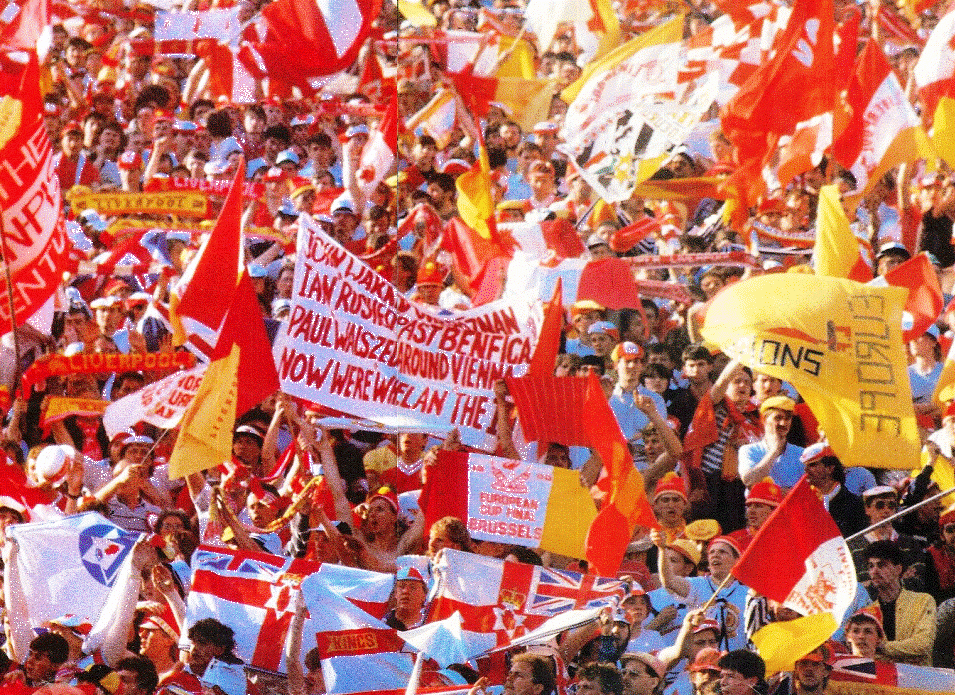
packed to bursting point. As this was Liverpool’s end of
the ground, it was a red and white carnival, with
supporters spilling out onto the road and massed on the
wall. From inside came all the familiar anthems amidst a
cacophony of shouting, foot-stamping and table-thumping.
Throughout the late 1970s and 1980s, pubs and bars by a
football ground and inside it were closed on match days,
without exception, and especially in Europe when an
English club or the national team was involved. It was,
on police orders, the (reluctantly) accepted norm.
You
were lucky if the whole city didn’t close. So to see
these bars open, right in front of the police, was a
culture shock for us, albeit a very welcome one, and all
but unprecedented for such a big game in Europe, defying
all logic, wisdom and common sense, and contradicting
every assurance from all the authorities. But if life is
made up of fixed and variable factors, that hordes of
football fans will take advantage of a bar open right by
a stadium is definitely one of the former. Leave the
chicken coop open and the fox will certainly get in.
Despite the strong advice –– rather than enforcement,
transparently –– not to open, the lure of quick fat
profits was presumably enough for the bar owners to take
the risk of damage, disturbance and adverse publicity.
That’s market forces for you I suppose –– if somebody
wants something and is prepared to pay for it, somebody
else will be prepared to supply it, regardless of the
consequences. Opening was a decision based on
straightforward, calculated self-interest, and, purely
from the commercial point of view, a successful one. The
profits would more than pay for a few hours of the
cleaners’ time. But it was astonishing, in the context
of the times and given the high profile of the match,
that they were allowed to open, by both the police and
the Brussels authorities. We felt like children with our
noses pressed against the outside of a sweet shop window
who had suddenly been invited inside to tuck in. It was
a wholly unexpected opportunity to grab another beer and
let rip with some singing and chanting to get in the
mood, a last chance to crank up the atmosphere before
the match. We weren’t going to miss it. We entered the
first and biggest bar. Inside the insane, heaving melee,
the mass of bodies had almost fused into a single
pulsing entity. Within seconds, our shirts were soaked
with sweat and beer that spilled from plastic glasses
held on high as people tried to push and worm their way
through. The toilets had long since ceased to cope, and
a trail ran from them to the pavement outside. The
super-competitive business of getting served was only
for the grimly determined or desperate, but we managed
it. The story of the stabbing had arrived before us,
fuelling the tension that hung heavy in the overpowering
hot stale air. There also seemed to be any number of
obviously forged tickets in existence, wads of them
being passed around in tens and twenties at a time, with
the instruction: "Get something for them if you can, or
get your mates in, or just dump them". For once, supply
seemed to outstrip demand, as handfuls of discarded
forgeries were tossed idly aside, fluttering earthwards
to be trampled soggy. Forgeries are always an ominous
harbinger of trouble; if they work and get people in,
they can cause serious congestion. If they don’t, they
can cause delays and unrest at the turnstiles or at
whatever point the forgery is detected as people are
turned away, or try to break through by force, or turn
nasty, or get arrested.
|
 |
|
|
With
about half an hour left to kick-off, we drank up and
left for the ten-minute walk to our end of the stadium.
The first security check, the most cursory and
superficial of body searches, revealed a disinterest
that almost bordered on the insulting to fans from the
country that consistently topped the hooligan export
league. We did not know yet, but these same security
checks at the other end of the ground were failing to
detect a replica handgun, which later turned out to be a
starting pistol ("Ooh it’s not a gun it’s a starting
pistol, OK fine you can bring it in then, no problem"),
to be brandished at the height of the carnage by an
Italian supporter before a worldwide TV audience of
millions. No other security check followed this one. We
just passed right through the sets of barricades, police
didn’t even stop us or ask for tickets. Suddenly we were
on our final approach. Away to our right, we could see
part of our crowd in one of the terraces, a vast curving
sweep of red and white bathed in sunlight. We followed
the signs for Blocks X and Y, past the main stand and up
a gentle slope. We didn’t quite know what to make of the
muffled thud that soon followed, not crisp enough for a
firecracker, not metallic enough for clanging gates, not
quite like any of the usual football match sounds.
Suddenly, ahead of us, a group of supporters came
clambering over the wall at the edge of Block Z,
shouting and gesticulating. At first we assumed it was
our lot trying to bunk in without tickets and being
turned back. More and more appeared, swarming over the
wall and charging down the bank towards us. But as they
drew nearer, running maniacally towards us, it quickly
became apparent they were not Liverpool supporters
trying to get in but Juventus supporters getting out.
And they were heading straight for us, at speed, maybe a
hundred or more. When faced with a number of rival
supporters charging at him, the average English football
fan’s experience tells him they are not coming for his
autograph. Phil’s eyes narrowed: "Bloody hell, these are
coming for us here –– quick, get a brick or something!"
The first group arrived, but just ran straight on past
us, wild-eyed, before barging into some more Liverpool
fans behind us. One Italian, wearing a silk
scarf like a headband, bandanna-style, launched into a
bizarre kung-fu routine with circling hands and trilling
noises, before sprinting off with the others. More and
more followed, all with the same wild demeanour. Most
odd, we thought, not familiar with this type of pre-match
behaviour, as we continued towards our entrance,
completely unaware of the significance of what we had
just seen and heard. Our first sight of the crumbly
stone walls and old-fashioned turnstiles conjured an
image of rosettes and rattles, Kenneth Wolstenholme
commentary and the old ‘Match of the Day’ theme tune. It
was tragi-comic to behold, like a faded glamorous
actress long past her prime auditioning for the part of
sex kitten. Outside the shabby exterior, an anarchic,
unsupervised queue swayed and swirled without pattern as
it shoved and pushed and sweated towards what seemed a
wholly inadequate number of turnstiles. Many of those
forged tickets were being used successfully. We
witnessed cash being handed over to turnstile operators
who then allowed them in. The sacred match ticket, that
took so much hard work to get hold of, seemed to have
been relegated to an optional extra for this strictly
ticket-only event. In another major departure from
convention, there were no police or stewards outside to
control the surging swaying mass, or just beyond the
turnstiles to check and control the access points. As
the pressure at the front of the queues built, those
behind were crying out for the pushing to stop – a
chilling foretaste of what was to come four years later
at Hillsborough.
 Having
finally got into the stadium, further reasons for the
turnstile chaos immediately presented themselves. Just
beyond the turnstile, a water pipe had fractured,
turning the area into a sea of reddy brown mud, in which
floated endless crushed paper cups and empty cans,
discarded wrappers from chocolate bars and bags of
crisps and other unidentifiable debris. A red Liverpool
FC cap lay forlornly semi-submerged. The mud lake was
too wide to jump across, so wading was the only
alternative. The result: apart from spattered jeans and
squelchy shoes and socks, it meant a build-up of bodies
just beyond the turnstile, restricting the smooth flow
of supporters into the ground from outside, at the
precise time and place where the crowd pressure was
greatest. Once over the water jump, the next obstacle
was a choking, swirling cloud of red dust, as the
decrepit building’s foundations were scuffed into life
by the stampede of thousands of pairs of feet. Ahead of
us, partly no doubt as a result of the cavalier approach
to ticket control and ground admission, the terracing
was a solid, impenetrable Red Sea with no parting –– and
there were still thousands outside waiting to get in,
most presumably possessing genuine match tickets and
assuming there would be space for them. But they, like
us, would have to lever their way through, prising
bodies apart and wedging their own into the tiny gap
created, which would snap shut instantly behind them as
they pushed forwards another few inches in the
sweltering body heat. On some of the crush barriers, the
concrete had crumbled away to reveal the exposed metal
reinforcing strips inside, rusted and twisted. We felt
an acute sense of disappointment at the standard of the
venue; this stadium did not make it feel like European
football’s grandest occasion. You expect to be
impressed, awestruck by the sense of occasion; I thought
back to the grandeur and pageant of the Stadio Olimpico
in Rome, the inspiring first impressions and the
explosion of sound and vision created by Liverpool’s
army of fans. In stark contrast, the inglorious Heysel
felt second-rate, squalid, shorn of style and class, and
with feeble organisation to compound it. We finally
found a position where we could see what should have
been the green of the pitch. Instead, we saw that the
entire near right-hand quarter of the vivid green
playing surface had been engulfed by a human spillage of
epic scale –– a tangled mass of fans, police, stewards,
officials, paramedics and photographers. We took this as
nothing more than yet another manifestation of
overcrowding and organisational incompetence. After all
the chaos, Don began to lose patience, with which he
probably isn’t over-blessed: "For fuck’s sake sort
yourselves out, this is shite", he yelled across the
terraces. "There’s been a bit of bother in that corner
lad, a crowd surge or something, a bit of fighting
like", came a voice from behind. If the match was to
start on time in twenty five minutes –– 20.15 kick-off
in those days –– there was an awful lot of clearing up
to do. In the UK, a TV audience of millions was
finishing dinner, fetching beer from the fridge and
settling down to watch the football. But what they, and
millions more across Europe and across the globe, saw
and heard instead were the first harrowing images of
people dying at a football match. Replay after replay of
clashes and charges between rival supporters was being
shown, interspersed with an ever-rising fatalities
figure. Around the globe, newsrooms sparked into
frenzied activity, phones and faxes chattering excitedly
as a major news story broke. Yet we inside the Heysel
Stadium, only yards from the eye of the hurricane, had
much less idea of the gravity of the situation than most
of the rest of Europe who were watching. Having
finally got into the stadium, further reasons for the
turnstile chaos immediately presented themselves. Just
beyond the turnstile, a water pipe had fractured,
turning the area into a sea of reddy brown mud, in which
floated endless crushed paper cups and empty cans,
discarded wrappers from chocolate bars and bags of
crisps and other unidentifiable debris. A red Liverpool
FC cap lay forlornly semi-submerged. The mud lake was
too wide to jump across, so wading was the only
alternative. The result: apart from spattered jeans and
squelchy shoes and socks, it meant a build-up of bodies
just beyond the turnstile, restricting the smooth flow
of supporters into the ground from outside, at the
precise time and place where the crowd pressure was
greatest. Once over the water jump, the next obstacle
was a choking, swirling cloud of red dust, as the
decrepit building’s foundations were scuffed into life
by the stampede of thousands of pairs of feet. Ahead of
us, partly no doubt as a result of the cavalier approach
to ticket control and ground admission, the terracing
was a solid, impenetrable Red Sea with no parting –– and
there were still thousands outside waiting to get in,
most presumably possessing genuine match tickets and
assuming there would be space for them. But they, like
us, would have to lever their way through, prising
bodies apart and wedging their own into the tiny gap
created, which would snap shut instantly behind them as
they pushed forwards another few inches in the
sweltering body heat. On some of the crush barriers, the
concrete had crumbled away to reveal the exposed metal
reinforcing strips inside, rusted and twisted. We felt
an acute sense of disappointment at the standard of the
venue; this stadium did not make it feel like European
football’s grandest occasion. You expect to be
impressed, awestruck by the sense of occasion; I thought
back to the grandeur and pageant of the Stadio Olimpico
in Rome, the inspiring first impressions and the
explosion of sound and vision created by Liverpool’s
army of fans. In stark contrast, the inglorious Heysel
felt second-rate, squalid, shorn of style and class, and
with feeble organisation to compound it. We finally
found a position where we could see what should have
been the green of the pitch. Instead, we saw that the
entire near right-hand quarter of the vivid green
playing surface had been engulfed by a human spillage of
epic scale –– a tangled mass of fans, police, stewards,
officials, paramedics and photographers. We took this as
nothing more than yet another manifestation of
overcrowding and organisational incompetence. After all
the chaos, Don began to lose patience, with which he
probably isn’t over-blessed: "For fuck’s sake sort
yourselves out, this is shite", he yelled across the
terraces. "There’s been a bit of bother in that corner
lad, a crowd surge or something, a bit of fighting
like", came a voice from behind. If the match was to
start on time in twenty five minutes –– 20.15 kick-off
in those days –– there was an awful lot of clearing up
to do. In the UK, a TV audience of millions was
finishing dinner, fetching beer from the fridge and
settling down to watch the football. But what they, and
millions more across Europe and across the globe, saw
and heard instead were the first harrowing images of
people dying at a football match. Replay after replay of
clashes and charges between rival supporters was being
shown, interspersed with an ever-rising fatalities
figure. Around the globe, newsrooms sparked into
frenzied activity, phones and faxes chattering excitedly
as a major news story broke. Yet we inside the Heysel
Stadium, only yards from the eye of the hurricane, had
much less idea of the gravity of the situation than most
of the rest of Europe who were watching.
|
|
No
commentary, no replays, no access to TV or the
authorities to feed us information, certainly no rumours
of deaths yet, just speculation. Still oblivious to the
nature and scale of the incident, we remained the
calmest and least horrified of observers. I’m sure it
looked incredibly callous, but we just didn’t know. We
just wanted the pitch cleared so the European Cup Final
could start, and grew more agitated with the authorities’
apparent inability to get even that right. Despite the
frenzied scurrying and frantic arm-waving of the
assembled legions of arm-banded officials, police and
the advance guard of the army, the situation seemed not
to change for what felt like an eternity. Their
hyperactivity contrasted sharply with the unnatural calm
that had settled over the red mass of supporters. With
kick-off so close, excitement levels should have been
approaching critical. Instead we waited in silence for
news, explanation or action, or at least some visible
signs of progress. Kick-off, if indeed there was going
to be one, would clearly be considerably delayed,
opening up the additional complication of probably
missing our last train back to Ostend. A man wearing a
Liverpool shirt suddenly appeared on the running track
surrounding the pitch, hotly pursued by another
supporter. After being chased for nearly half the length
of the pitch, he was felled by a brick to the head. The
pursuing police seized the chasee –– though not the
chaser –– and frogmarched him away with highly visible
and almost over-compensatory firmness for their hitherto
supine response. Cops chasing fan chasing fan, it was a
farce that belonged more to The Benny Hill Show than the
European Cup Final. There would clearly be no football
for some time. We decided to move to the back, away from
the packed terracing, to find some less competitive
oxygen. It also gave us a clearer view of the chaos on
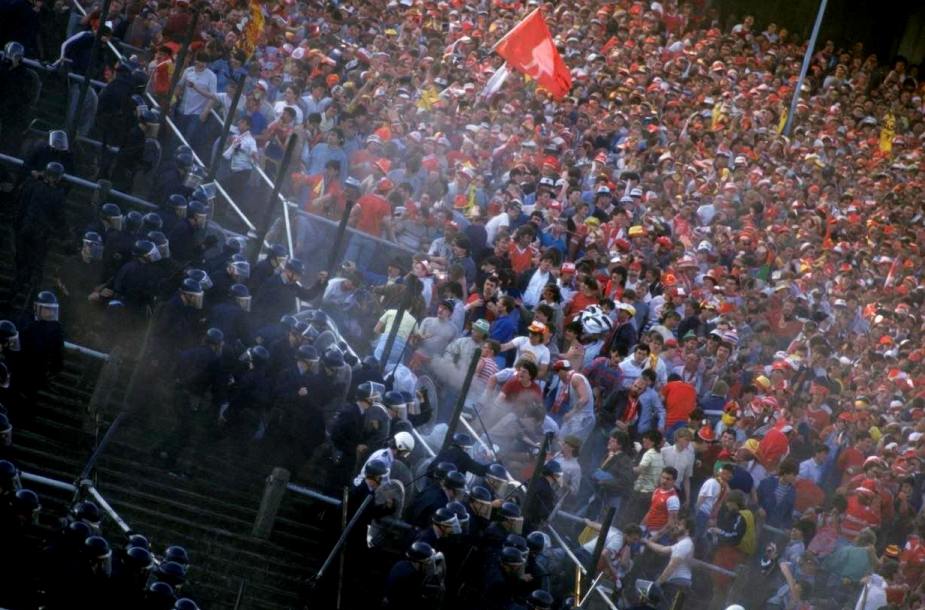
the pitch. Two concentric semi-circles of armed police
with helmets and riot shields now spanned the entire
Liverpool section of the crowd, staring blankly back at
us with their backs to the pitch. Whatever had happened,
it looked pretty clear where the blame was being
apportioned. With all the police attention directed
towards us, the Juventus crowd remained a police-free
zone. A rhythmic chant rolled out from the Italian
masses, thousands of black-and-white flags jigging
suddenly into life. One bore the inflammatory message ‘Reds
are Animals’. Unless someone had brought a blank flag
and felt-tip marker pen in to the stadium with them,
ready to tailor a relevant message on the spot according
to events as they unfolded, at least one Italian fan had
a preconception regarding the English fans opposite them.
A few red flags waved half-heartedly in token, muted
response, but by now nobody seemed in the mood. A large
electronic scoreboard –– just about the stadium’s only
concession to the 20th century –– flashed
incomprehensible digital messages, whilst a public
address system babbled incessantly and totally
unintelligibly. A mood of deep gloom and foreboding
pressed down like a heavy, soggy blanket. All we’d
looked forward to for so long, built ourselves up for,
dissipated into the clammy evening air. By this time, at
the opposite end of the ground, a group of Juventus
supporters had got to work dismantling the perimeter
fence, but the police, preoccupied with staring at us,
either didn’t notice or didn’t care.
|
|
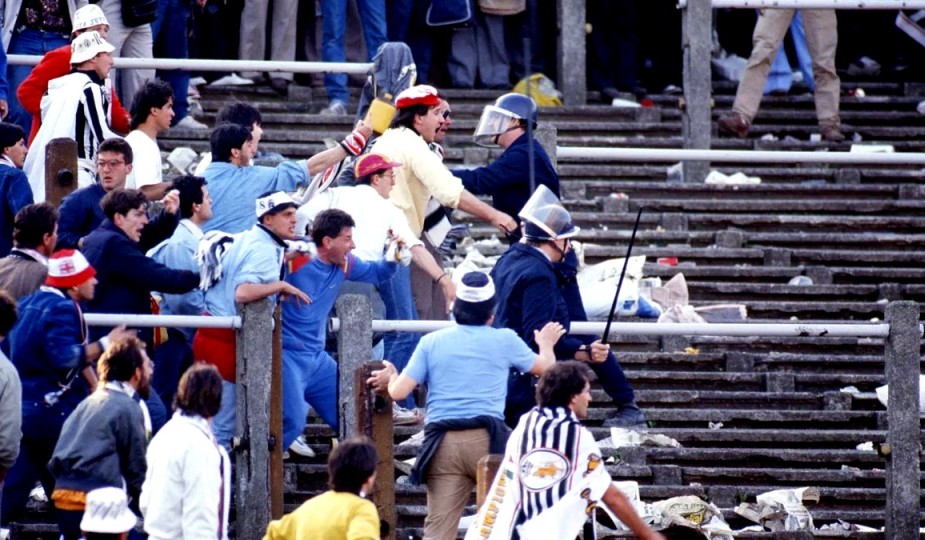
A
group broke through and swarmed over the mangled debris
of the fence. Another roar rolled from the Italian end
as a group of 40 or 50 began to charge round the running
track towards our end. (See photo page 79.) We watched
with mild bemusement. A crowd of 15,000 does not feel
threatened by 40 or 50 potential attackers, but the
evening was becoming more surreal by the minute. It was
tempting to shout a pantomime-style "Behind you!" to the
police, who steadfastly refused to switch their
expressionless gaze from us as the Italians grew ever
closer behind them. Some of the Italians wore scarves
bearing the Ultras’ skull-and-crossbones insignia,
pulled cowboy-style over the mouth and nose. When they
reached the seated Liverpool section they came to a halt
and began hurling stones, coins, cans, even a metal
waste bin into the packed seating. The response from the
Liverpool supporters was immediate, and a random
assortment of debris (including the returning waste bin)
arced from the stand towards the Italians on the running
track, who scattered to ironic jeers as the bin crashed
to earth and bounced amongst them like a loose firework.
Most of the police continued to ignore the entertainment
from a distance of no more than twenty yards away, but
eventually one or two began to take a mild interest,
tilting their heads ever so slightly away from us and
towards the skirmish behind them on the running track. A
detachment finally broke away and another half-hearted
cartoon-style chase ensued, to get the errant Italians
back down the running track to their allotted territory,
accompanied by jeers of derision. The Olympic 4 x 100
Police Chasing Fans event. Lane discipline was poor. By
now, large sections of the perimeter fence at the
Juventus end of the ground were under assault. No longer
able to ignore the growing disorder, a large contingent
of police was despatched towards it from somewhere
within the bowels of the stadium. Dressed in curious
blue overalls and helmets, they looked more like armed
plumbers than crime fighters as they marched
purposefully towards the Italians, to more ironic cheers
from Liverpool’s supporters. They were immediately
bombarded with debris –– there was now plenty of it
lying around –– by the Italian fans and, seriously
undermanned, they mounted a swift and decisive retreat.
The apparent timidity of the Dyno-Rod police seemed to
further encourage the Italian fans, who this time
mounted a major pitch incursion; with many hundreds now
on the pitch behind the goal and around the penalty
area. More reinforcements arrived, with what seemed like
divisions of militia marching formally and grandly into
the stadium, only to be stricken by the same lethargy
and indecision that afflicted their colleagues. The
battle waged on as the rest of us watched on, totally
bemused yet bizarrely entertained by this degeneration
through anarchy towards farce. There was still no sign
of the football, and we still didn’t know what had
happened or why there was this interminable delay in
getting the game started. It was clear something major
had gone wrong, but we still had no idea what.
Fonte:
Lfchistory.net
© 20 ottobre 2009 (Where I
Was Standing © Chris Rowland and Paul Tomkins)
Fotografie: GETTY IMAGES
© (Not for commercial use)
© Adriano Lazzarini
© GPRF Publishing
©
|
|